
Lean: A Unified Platform for Verification, Programming, and AI

Monday recap
On Monday: What Lean is and how it works.
Today: Lean applications and who uses Lean
For anyone who missed Monday:
-
Programming language and proof assistant. Same language for code and proofs.
-
Small trusted kernel. Multiple independent kernels.
-
Lean is implemented in Lean. Very extensible.
AWS and Lean
AWS uses Lean across multiple domains:
-
Cedar — verified authorization policy language
-
SampCert — verified differential privacy
-
Strata — language syntax and semantics
-
Waimea — tensor compiler for Trainium
Cedar: Authorization Policy Language
Cedar: open-source authorization policy language.
Cedar spec: model written in Lean.
Cedar: Verified Components
Used by AWS Verified Permissions and AWS Verified Access. Policies separate from application logic.
Three examples of verified components: evaluator, authorizer, validator.
-
forbid_trumps_permit: if any forbid policy is satisfied, the request is denied -
allowed_only_if_explicitly_permitted: a request is allowed only if at least one permit policy is satisfied -
typecheck_is_sound: if the validator accepts a policy, evaluation produces a boolean
Cedar: Verification Queries
Verification queries proved sound and complete against a formalized symbolic compiler. SMT encoder and solver are trusted.
-
verifyNeverErrors— policy won't error -
verifyAlwaysAllows,verifyAlwaysDenies -
verifyImplies— one policy set implies another -
sound_policy_slice— authorization result is the same for the full set or the relevant slice
Originally built with Dafny, migrated to Lean.
"We've found Lean to be a great tool for verified software development." — Emina Torlak
Cedar: The Engineering Story
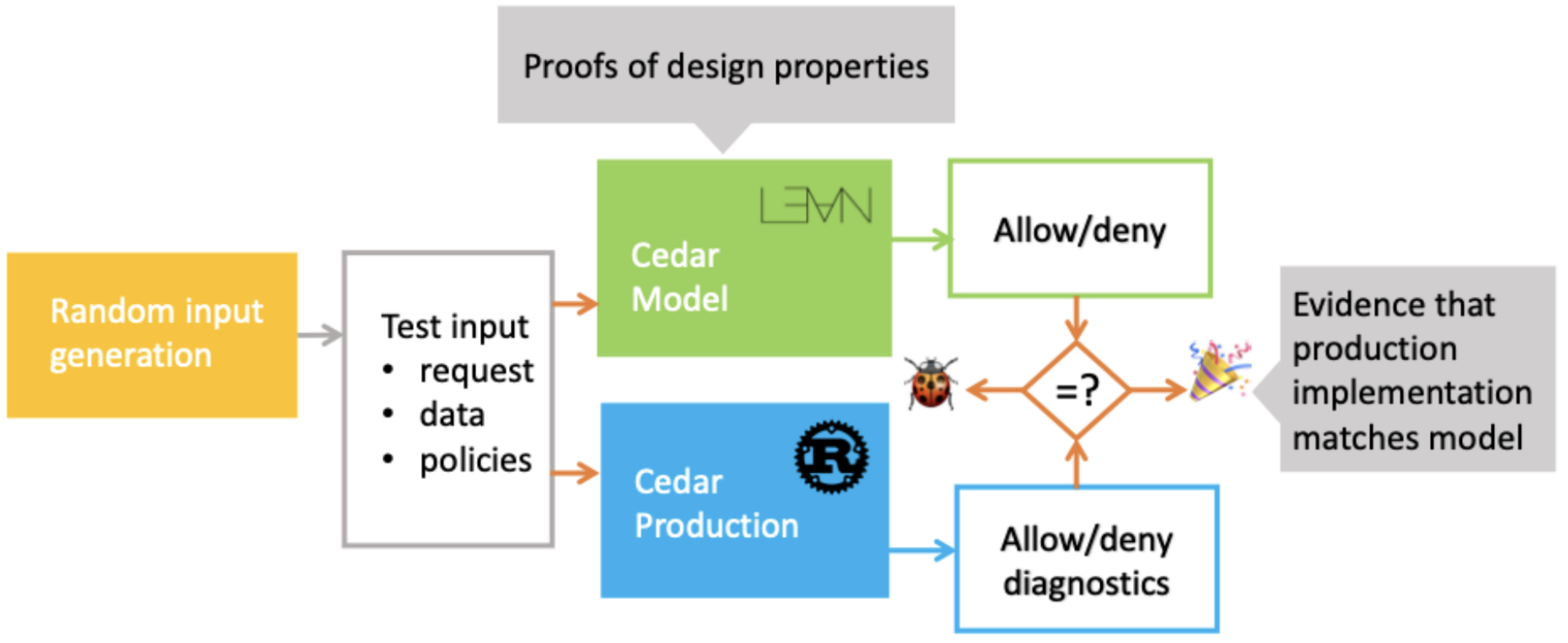
Executable Lean model alongside Rust production code. Lean model ~10x smaller than Rust.
-
~100M differential random tests nightly. Lean: 5 μs/test. Rust: 7 μs/test.
-
Release gate: no Cedar version ships unless model, proofs, and differential tests are current.
SampCert: Verified Differential Privacy
Differential privacy: the gold standard for privacy-preserving data analysis.
The problem: implementing DP correctly is hard. Bugs in random number generation and floating-point approximations have destroyed privacy guarantees in real systems. Mironov's attack exploited floating-point to break DP.
SampCert (led by Jean-Baptiste Tristan): first comprehensive, mechanized foundation for executable DP implementations.
-
12,000+ lines of Lean proof
-
Discrete Laplace and Gaussian sampling algorithms, proved correct
-
Generic DP foundation: pure DP, zero-concentrated DP, Renyi DP
-
Composition theorems verified generically
SampCert: What's Verified
-
Discrete Laplace sampler: proved to produce samples following the exact PMF
-
Discrete Gaussian sampler: proved correct using Fourier analysis and the Poisson summation formula from Mathlib
-
Composition: composing mechanisms with budgets γ₁ and γ₂ yields budget γ₁ + γ₂
-
Postprocessing: functions that don't access the secret database don't degrade privacy
Key innovation: a probability monad (SLang) embedded in Lean.
Heavy use of Mathlib: Fourier analysis, Poisson summation, measure theory, number theory, topology.
SampCert: Deployed at AWS
Custom code extractor: the deployed artifact does not go through the Lean compiler. TCB includes the extractor, not the Lean compiler.
Performance: SampCert outperforms diffprivlib by >2x for discrete Gaussians.
Deployed in AWS Clean Rooms Differential Privacy, a production AWS service.
PLDI 2025: "Verified Foundations for Differential Privacy."
SampCert uses the Poisson summation formula from Mathlib to prove a production privacy service correct.
Strata: Language Syntax and Semantics
Strata: extensible platform for formalizing language syntax and semantics. Built in Lean. Open source.
Key idea: dialects (inspired by MLIR). Orthogonal, composable building blocks for modeling programming constructs. Define a dialect, get AST, parser, pretty printer, type checker.
-
Core, C_Simp, Laurel, SMTLib, Python, Boole
-
Laurel pipeline: Python/Java/JavaScript → Laurel → Strata Core → VCG → SMT
-
Dialect Definition Mechanism (DDM): embedded DSL in Lean for defining syntax and typing rules
Strata: Why Lean
Lean's role:
-
Extensibility via metaprogramming (DDM is an embedded DSL)
-
Verification of Strata's own implementation
-
Long-term: using Lean to reason about programs written in Strata dialects
Monday's MiniRadix was a toy version of this idea. Strata is the industrial-scale version.
Boogie/Dafny-style verification infrastructure, built in Lean and extensible via Lean's metaprogramming.
Waimea: Verified Compiler for Trainium
CompCert-style verified compiler for AWS Trainium, Amazon's custom AI accelerator chip. ~200,000 lines of Lean code.
-
The ISA specification changes several times per week. Not a fixed ISA like x86.
-
Lean provides an up-to-date simulator that hardware and verification engineers share.
-
Lean + Claude keeps the team in sync with hardware changes.
-
Several hundred instructions per generation. AI is essential for keeping up.
Long-term goal: end-to-end compiler verification. Source program compiles to Trainium machine code, with a proof that the compilation preserves semantics.
Waimea: Why It Matters
A single miscompilation on a training run that costs millions of dollars in compute is catastrophic.
Also used Claude Code to port the Flocq floating-point library from Rocq to Lean autonomously, building the numeric foundations needed for hardware verification.
Anneal: Verified Unsafe Rust at Google
Google's zerocopy team building "literate verification" for unsafe Rust using Lean and Aeneas.
Unsafe Rust accounts for ~2/3 of vulnerabilities in the Rust ecosystem. Safety invariants documented only in prose comments.
Anneal: developers write Lean specifications directly in Rust doc comments. cargo anneal verify runs the pipeline: Charon → Aeneas → Lean.
Quick Aeneas recap (Monday covered SymCrypt (Microsoft) which also uses Aeneas): Aeneas (Son Ho, Microsoft) translates safe Rust to pure functional Lean code. The bridge that makes Rust verification in Lean practical.
Anneal: AI-Ready Verification
Specs and proofs live in Rust doc comments alongside the code.
-
specblocks for safe code -
unsafe(axiom)blocks for opaque unsafe operations with pre/post conditions -
Type invariants for struct safety properties
Designed for AI agents: Anneal demonstrated that their AI (Antigravity) can author unsafe Rust code and prove its soundness.
Veil: Verified Distributed Protocols
Veil: verification of distributed protocols. Built on Lean as a library using Lean metaprogramming.
-
Push-button verification via SMT (cvc5/Z3) for decidable fragments
-
Full interactive proofs in Lean when automation falls short
-
Seamless transition between the two modes
-
Foundational: Veil's VCG is proven sound w.r.t. the specification language semantics.
-
16 distributed protocol case studies. All 16 verified. Ivy failed on 2. 87.5% verified in under 15 seconds.
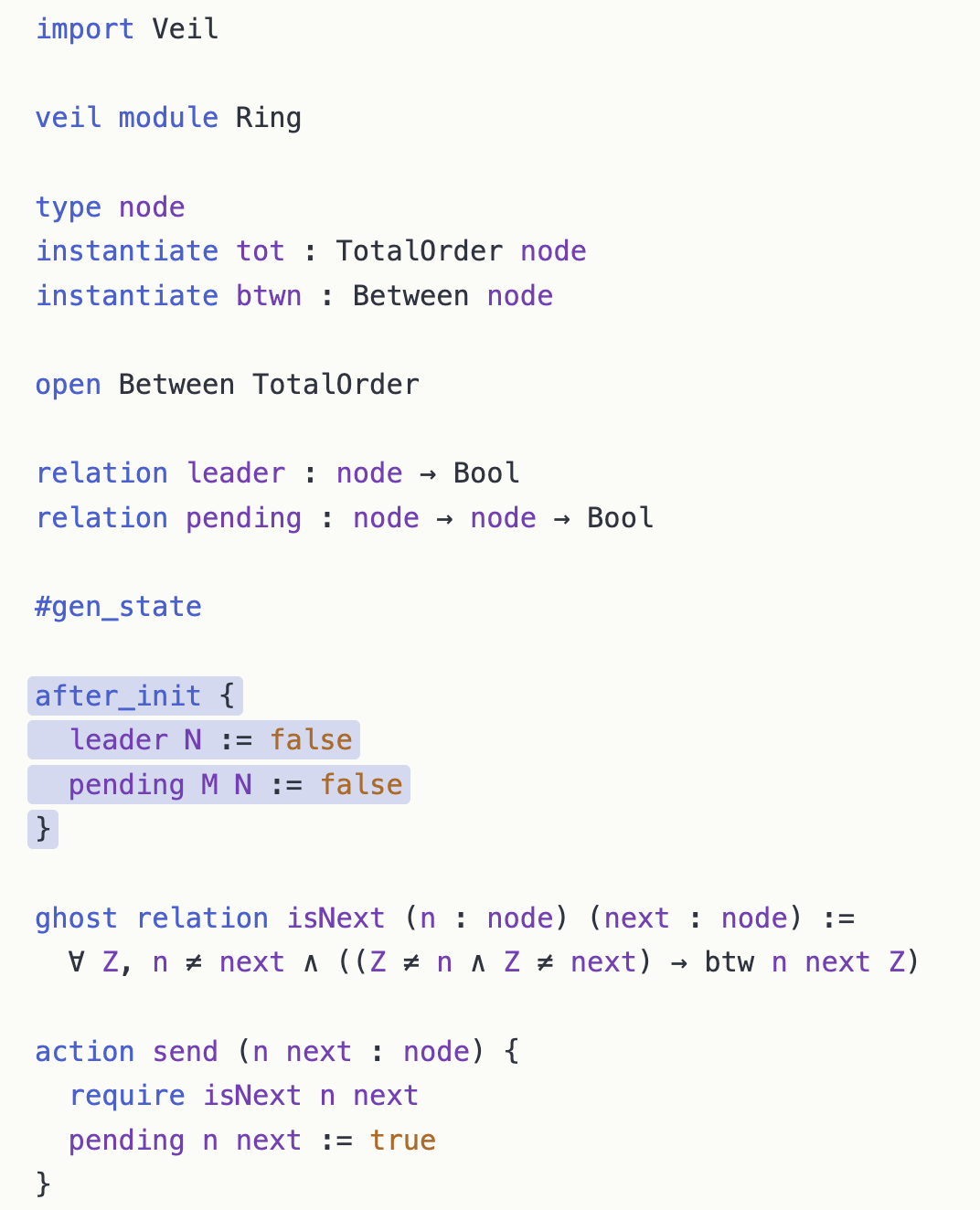
Veil: Beyond EPR
Verified Paxos, Suzuki-Kasami, Reliable Broadcast outside the decidable EPR fragment. This is where Ivy's automation breaks down.
The Rabia finding: while porting Rabia from Ivy + Rocq to Veil, they spotted an invariant discrepancy that went undetected across two separate tools. One unified framework caught what two couldn't.
Loom (POPL 2026): the foundational layer underneath Veil. Correct-by-construction verifiers from monad transformer algebras.
One Platform, Many Domains
Cedar is access control. SampCert is privacy. Strata is languages. Waimea is compiler. SymCrypt is Crypto. Anneal is unsafe Rust. Veil is distributed protocols.
AWS, Google, Microsoft, NUS, Nethermind, Galois use Lean.
Independent third-party adoptions:
-
Nethermind: verified INTMAX2 zkRollup (5,000 lines of Lean), CertiPlonk, Halo2, EVM + Yul
-
Galois: verified Jolt zkVM. Custom tactic saved 6,800+ lines of proof. One XOR proof: 213 lines → one automated line.
AI + Lean
Companies are being built on this: Harmonic, Axiom, Math Inc, Logical Intelligence, Google DeepMind, ByteDance teams.
Many job opportunities.
Harmonic Aristotle: IMO Gold
Harmonic: a startup building AI systems that reason formally.
IMO 2025 Gold Medal: Aristotle solved 5 out of 6 problems with formal Lean proofs. First AI system to achieve gold with formal proofs.
Architecture:
-
Lean proof search: MCTS with a learned value function. RL-trained on Lean proof search.
-
Informal reasoning: generates conjectures and lemmas in natural language, then formalizes them as Lean statements.
-
Geometry solver: dedicated symbolic solver. Open-sourced as Yuclid.
Training: RL on Lean proof search. Test-time training.
Aristotle: Beyond Competition Math
Aristotle made contributions to Mathlib. Category theory, homological algebra.
Verina benchmark: 96.8% resolution rate (160/189 Lean specifications proved). Found specification bugs in the benchmarks.
#1 on ProofBench by 15% margin.
Fully agentic: Aristotle works directly in Lean projects. It reads project files, understands dependencies, writes proofs that integrate into existing code.
Lean serves as the training environment, the evaluation harness, and the deployment target.
Move Borrow Checker: The Problem
Ilya Sergey (VERSE lab) formalized and verified Move's borrow checker in Lean. 39,000 lines of mechanized metatheory in 27 working days, using Claude as an AI coding assistant.
Move: smart contract language for the Sui and Aptos blockchains. Rust-like ownership discipline. References are access paths rooted in local variables. No lifetime annotations.
The borrow checker: tracks reachability between references using regular expressions over field paths.
Move Borrow Checker: What Was Proved
Formalized in Lean:
-
Relational type system encoding
-
Executable algorithmic type checker
-
Soundness proof: the algorithmic checker is sound w.r.t. the relational rules
-
Runtime semantics as a definitional interpreter
-
Type soundness: progress + preservation. Any function accepted by the type checker never reaches a preventable error across all execution paths.
39,000 non-blank lines. 267 commits. Zero axioms, zero sorry. 153 preservation lemmas across 23 statement forms.
Move Borrow Checker: AI's Role
Claude (Opus 4.5/4.6) handled proof repair, pattern propagation, routine preservation cases.
Human insight still needed for novel proof strategies (e.g., weakening lemmas, inter-procedural reasoning for function calls took two days).
27 working days. Estimated 5-6 months without AI. Second largest PL metatheory mechanization in Lean, and very likely the largest accomplished predominantly using AI.
Your Program Is Already a Specification
"I am running out of things to Prove." — Son Ho, SymCrypt, Microsoft
In the AI era, writing specifications is a critical skill.
A naive program is a specification.
inductive Tree (α : Type u) where
  | leaf
  | node (left : Tree α) (a : α) (right : Tree α)

def Tree.map (f : α → β) : Tree α → Tree β
  | .leaf => .leaf
  | .node l a r => .node (map f l) (f a) (map f r)
My prompt to AI: "Implement a tail-recursive version, and prove it computes the same result."
AI's Response: Tail-Recursive Implementation
mutual
def Tree.mapGo (f : α → β) (stack : List (Tree.Frame α β))
(t : Tree α) : Tree β :=
match t with
| .node l a r => mapGo f (.visit (f a) r :: stack) l
| .leaf => mapBack f stack .leaf
termination_by 4 * t.size + stackWeight stack + 1
decreasing_by all_goals simp only [stackWeight, size]; omega
def Tree.mapBack (f : α → β) (stack : List (Tree.Frame α β))
(result : Tree β) : Tree β :=
match stack with
| .visit a r :: rest => mapGo f (.done result a :: rest) r
| .done l a :: rest => mapBack f rest (.node l a result)
| [] => result
termination_by stackWeight stack
decreasing_by all_goals simp only [stackWeight]; omega
end
Two mutually recursive functions with an explicit stack. A termination measure. omega closes all obligations.
The Equivalence Theorem
theorem Tree.mapTR_eq_map (f : α → β) (t : Tree α) :
Tree.mapTR f t = Tree.map f t := by
simp only [Tree.mapTR, Tree.mapGo_spec, Tree.applyStack]
I wrote 6 lines. AI wrote 70 lines of optimized code and correctness proof, with no supervision. The simple version was the specification.
On Trust
What do I have to trust in order to trust a Lean proof?
Trust is layered. Each layer reduces what you have to believe.
-
Everyday: blue check +
#print axioms -
Replay:
lean4checkerre-runs the kernel on.oleanoutput -
Gold standard:
comparatorin a sandbox with multiple independent kernels
Everyday Trust: Axioms and the Blue Check
Blue checkmark: the elaborator accepted the proof.
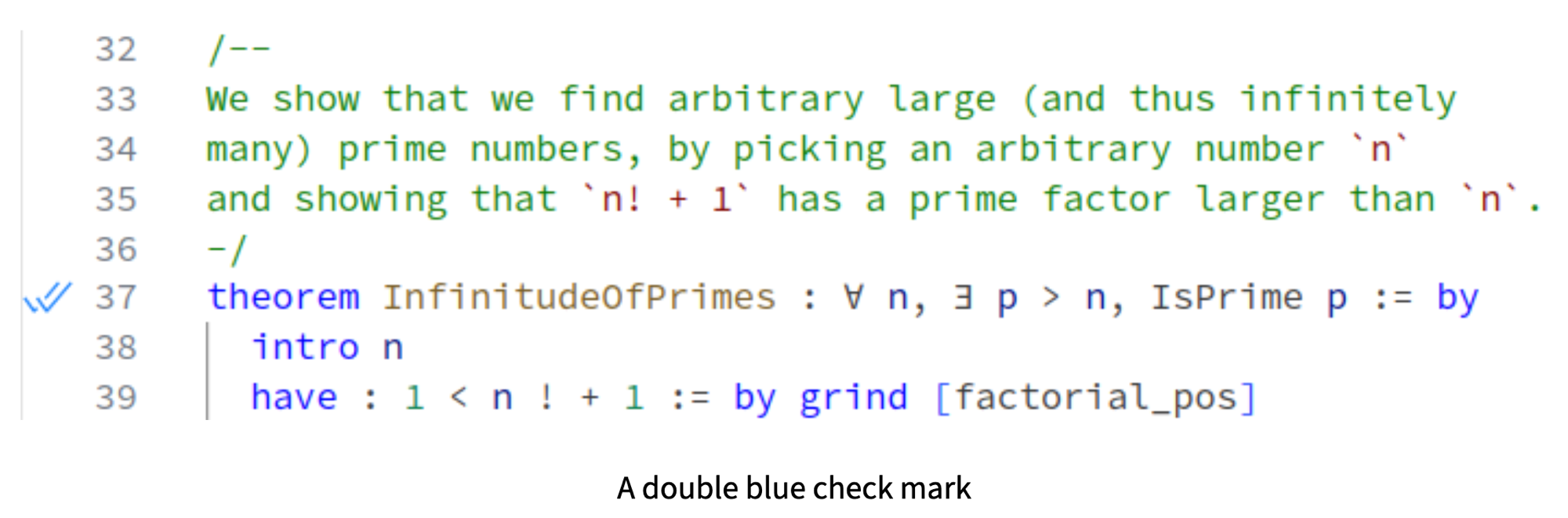
#print axioms thmName: list the axioms the theorem transitively depends on.
-
Axioms in stdlib:
propext,Classical.choice,Quot.sound. -
sorryAx→ incomplete proof. -
Custom axioms → soundness depends on them.
-
Lean.trustCompiler→ native evaluation in the TCB (deprecated since 4.29).
Re-checking Proofs: lean4checker
lean4checker replays declarations from .olean files through the kernel in a fresh context.
Catches bugs in meta-programs that intentionally bypass the kernel or corrupt memory.
Caveat: it trusts that .olean files are well-formed. A malicious library cannot be validated this way.
Gold Standard: comparator + External Checkers
-
Builds the proof in a sandbox
-
Exports it in a format validated by multiple checkers
-
Replays through Lean's kernel and independent implementations (e.g.,
nanodain Rust) -
Curated formal statements of known conjectures (e.g., Formal Conjectures) provide a human-verified reference point.
-
External checkers implement their own pretty printers independently of Lean.
Implementation bugs in any single checker are caught by disagreement with another.
Lean Kernel Arena hosts additional external checkers for manual verification.
Coming soon: Comparator at live.lean-lang.org
On Trust: Lean as a Programming Language
If you are using Lean as a programming language, you are also trusting:
-
Our compiler, implemented in Lean
-
Our runtime, implemented in C/C++
-
LLVM
-
Any other code external to Lean that is linked in
CSLib
CSLib aims to be a foundation for teaching, research, and new verification efforts, including AI-assisted.
A Foundation for Computer Science in Lean
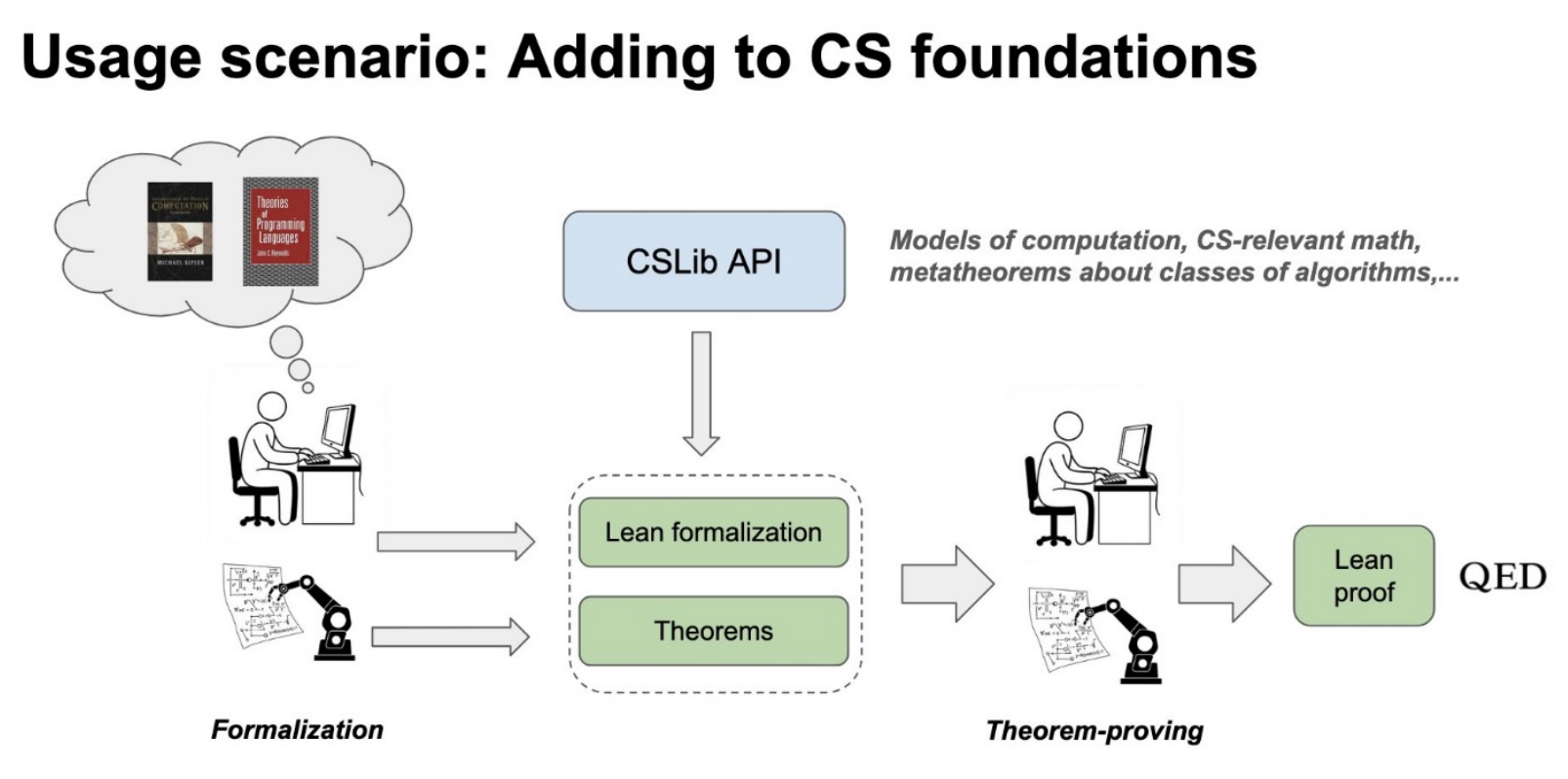
Steering committee: Clark Barrett, Swarat Chaudhuri, Jim Grundy, Pushmeet Kohli, Leo de Moura, Fabrizio Montesi.
"Lean Rocks": A Student's Story
A student with no formal cryptography training used Lean to implement point-and-permute garbled circuits (MPC).
Circuit DSL via metaprogramming, OpenSSL FFI bindings, monadic imperative evaluation, and formal proofs of encode/decode correctness.
"I genuinely do not know of another tool that can do all of the following: ML-style functional programming, metaprogramming so easy you can do it just to make your life easier, access to every C library ever written, honest to god proofs for your pure code, monadic style imperative programming."
"This was so easy I could actually use it to understand something! I was assisted! By my proof assistant!" — Markus de Medeiros
Why Lean?
-
Kernel trust: RL can't hack it. Multiple independent kernels.
-
Mathlib as training data: 200,000+ theorems, 2.2M+ lines.
-
Extensibility: tactics, metaprogramming, embedded DSLs.
-
Community: 8,000+ GitHub repos, 200,000+ VS Code + Open VSX installs.
ACM SIGPLAN Award 2025: "Lean has become the de facto choice for AI-based systems of mathematical reasoning."
How to Get Started
Concrete entry points:
Summary
Lean FRO is a nonprofit. 20 engineers. Not controlled by any single company.
One platform: verification, programming, AI.
Deployed across multiple domains.