
Proof Automation and AI

Today
-
simp: the rewriting engine you have been using — how to use it well. -
grind: congruence closure, E-matching, and theory solvers, native to dependent type theory. -
bv_decide: SAT-based decisions for bit-level code, kernel-checked. -
AI: what it already does with Lean, and why trust still comes from the kernel.
Do We Still Need Proof Automation?
"I thought AI would prove all theorems for us now."
-
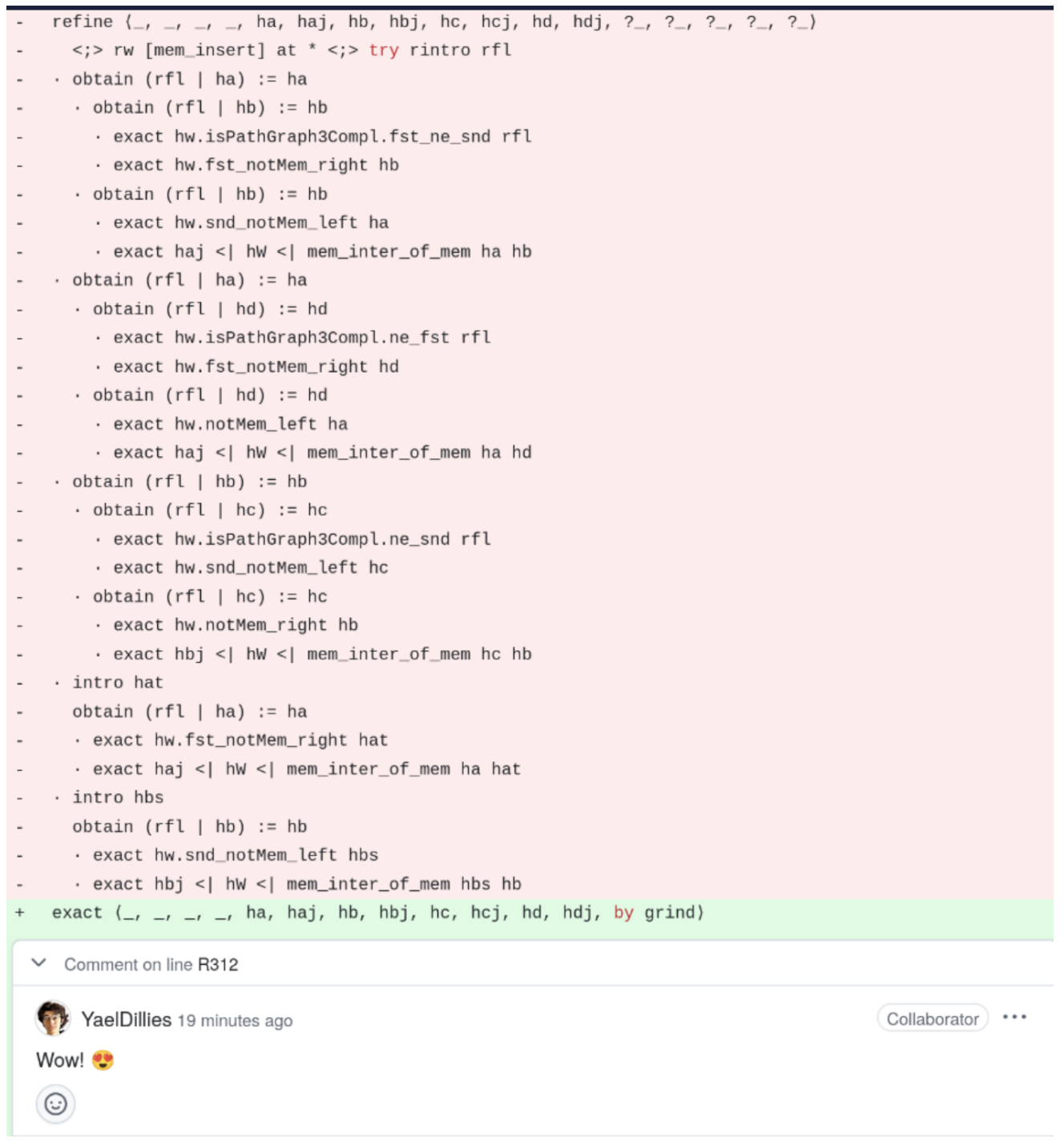
Tactics are the moves of the game — for humans and for AI.
-
Better tactics = shorter proofs.
-
Shorter proofs = smaller search trees = more capable AI.
-
Compact proofs = better training data.
simp: Rewriting with a Database
example (xs : List Nat) : (xs ++ []).map (· + 0) = xs := by
simp
-
simprewrites with@[simp]lemmas, left to right, until no rule applies. -
Thousands of library lemmas are annotated; your own join with
@[simp]orsimp [myLemma]. -
simp at hrewrites a hypothesis;simp_allsaturates hypotheses and goal together.
What Makes a Good simp Lemma
def double (n : Nat) : Nat := 2 * n
@[simp] theorem double_eq (n : Nat) : double n = 2 * n := rfl
theorem double_add (a b : Nat) :
double (a + b) = double a + double b := by
simp +arith
-
Left side more complex than the right: rewriting must make progress toward a normal form.
-
The set must be confluent enough: order should not matter.
-
Recall Lecture 2: one lemma per helper function, stated in the normal form you want.
Conditional Rewriting
def safeDiv (a b : Nat) : Nat := if b = 0 then 0 else a / b
@[simp] theorem safeDiv_self (h : b ≠ 0) : safeDiv b b = 1 := by
simp [safeDiv, h]
exact Nat.div_self (Nat.pos_of_ne_zero h)
example (n : Nat) (h : n ≠ 0) : safeDiv n n + 1 = 2 := by
simp [h]
example (n : Nat) (h : n > 5) : safeDiv n n + 1 = 2 := by
simp (disch := grind)
-
simplemmas may have hypotheses;simpdischarges them recursively (with itself, and with the facts you pass). -
This is where rewriting starts needing search — the boundary where
grindtakes over.
Discovery: simp?, apply?, exact?
-
simp?— closes the goal, then prints the minimalsimp only [...]call. Use it, then paste the result: faster and more robust. -
apply?/exact?— search the library for lemmas matching the goal. -
Loogle — search by type shape from the browser or editor.
Automation is also for finding the lemma, not only for closing goals.
Where simp Stops
example (x y : Int) (h₁ : 2 * x + 3 * y = 7) (h₂ : 3 * x - y = 5) :
x = 2 := by
grind
-
No rewrite rule solves a linear system: this needs arithmetic reasoning, not normalization.
-
Equalities must also flow between hypotheses, through function applications, into case splits.
-
That combination — rewriting + theories + propagation — is
grind.
What is grind?
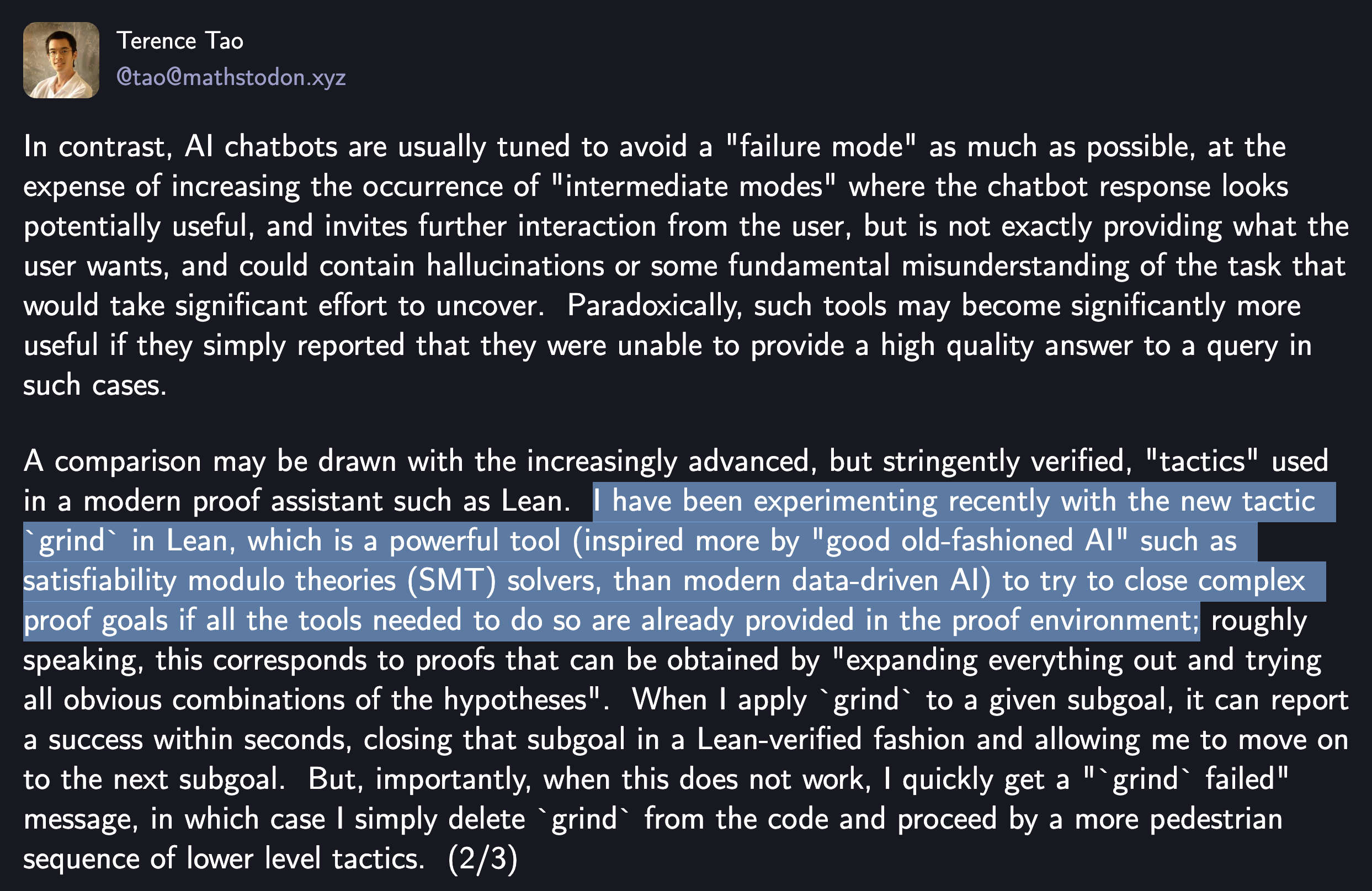
New proof automation, shipped in Lean v4.22. Kim Morrison and me.
A virtual whiteboard, inspired by modern SMT solvers.
-
Writes facts on the board. Merges equivalent terms.
-
Cooperating engines: congruence closure, E-matching, constraint propagation, guided case analysis.
-
Satellite theory solvers: cutsat (linear integer arithmetic), commutative rings (Gröbner bases), linarith, AC.
-
Native to dependent type theory. No translation to first-order logic.
-
Produces ordinary Lean proof terms. Kernel-checkable.
The Whiteboard: Congruence Closure
example (f : Nat → Nat) (a b c : Nat)
(h₁ : a = b) (h₂ : f b = c) : f a = c := by
grind
-
The E-graph maintains equivalence classes of terms:
a = bmerges the classes ofaandb. -
Congruence: equal arguments give equal applications, so
f aandf bmerge too. No rewriting happens — this is union-find. -
Every other engine reads from and writes to this board.
E-matching: Instantiating Lemmas
@[grind =] theorem fg {x} : f (g x) = x := by
unfold f g; grind
example {a b c} : f a = b → a = g c → b = c := by
grind
-
Library authors annotate theorems;
grindinstantiates them by E-matching: pattern matching modulo the board's equalities. -
[grind =]uses the left-hand side as the pattern. Notef (g c)appears nowhere in the goal: the board knowsa = g c, sof amatchesf (g ?x), the instancef (g c) = clands on the board, and congruence chainsb = f a = f (g c) = c. -
This is what makes annotation-driven automation robust: lemmas fire when the equalities match, not the syntax.
Annotating Your Own Library
@[grind =] theorem State.get_set_same (σ : State) (x : String) (v : Int) :
(σ.set x v).get x = v := by
simp [State.get, State.set]
@[grind =] theorem State.get_set_ne (σ : State) (x y : String) (v : Int)
(h : y ≠ x) : (σ.set x v).get y = σ.get y := by
simp [State.get, State.set, h]
example (σ : State) (h : σ.get "y" = 5) :
((σ.set "x" 1).set "z" 2).get "y" = 5 := by
grind
The State API is Lecture 2's; the two annotations make grind an
expert in it — Lecture 4 runs on exactly these two lemmas.
Forward Rules: [grind →]
def divides (a b : Nat) : Prop := ∃ k, b = a * k
@[grind →] theorem divides_trans (h₁ : divides a b) (h₂ : divides b c) :
divides a c := by
obtain ⟨k₁, rfl⟩ := h₁
obtain ⟨k₂, rfl⟩ := h₂
exact ⟨k₁ * k₂, Nat.mul_assoc a k₁ k₂⟩
example (h₁ : divides a b) (h₂ : divides b c) (h₃ : divides c d) :
divides a d := by
grind
-
[grind →]marks a forward rule: the patterns come from the premises — when matching facts are on the board, the conclusion is added. ([grind ←]is the dual: patterns from the conclusion.) -
Transitivity is the canonical case: two firings chain the three hypotheses into
divides a d. -
Forward chains can grow;
grindbounds instantiation rounds, and its diagnostics list every instance created.
Satellite Solvers, Activated by Type Classes
Theory solvers engage automatically when the type classes are present:
-
cutsat — linear integer arithmetic;
Int,Nat,Int32,BitVec n,Fin n. -
Ring —
CommRing,Field,IsCharP: Gröbner-basis reasoning. -
linarith — ordered modules: linear arithmetic over ordered fields.
-
AC — any associative-commutative operator.
Linear Integer Arithmetic
example (x y : Int)
: 27 ≤ 11 * x + 13 * y →
11 * x + 13 * y ≤ 45 →
-10 ≤ 7 * x - 9 * y →
7 * x - 9 * y ≤ 4 → False := by
grind
-
cutsat: a complete decision procedure for linear integer arithmetic — the workhorse for indices, sizes, and bounds in program verification. -
lia(Lecture 2) iscutsatwithout the rest ofgrind.
Commutative Rings
example (x : BitVec 8) : (x - 16) * (x + 16) = x ^ 2 := by
grind
-
BitVec 8is a commutative ring of characteristic 256 — the ring solver proves this by normalization; no bitvector theory needed. -
The same solver handles polynomial identities over
Int,Rat, and anyCommRing.
Theory Combination
example [CommRing α] [NoNatZeroDivisors α]
(a b c : α) (f : α → Nat)
: a + b + c = 3 →
a ^ 2 + b ^ 2 + c ^ 2 = 5 →
a ^ 3 + b ^ 3 + c ^ 3 = 7 →
f (a ^ 4 + b ^ 4) + f (9 - c ^ 4) ≠ 1 := by
grind
Three solvers meet at the E-graph:
-
Ring solver derives
a^4 + b^4 = 9 - c^4. -
Congruence closure lifts it to
f (a^4 + b^4) = f (9 - c^4). -
Linear integer arithmetic closes
2 * f (9 - c^4) ≠ 1.
The Nelson–Oppen playbook, inside dependent type theory — no SMT translation layer.
Guided Case Analysis
-
grindsplits onmatchexpressions,ifs, and annotated disjunctions — with heuristics to avoid explosion. -
Recall the ladder from Lecture 2:
mkAdd.eq_defhandedgrindthe match equations, and it did the case analysis itself. -
Case analysis is where automation costs blow up; controlling it is half the engineering.
grind in Practice
-
5,000+
grindcalls in Mathlib. -
Used daily on goals from algebra, program verification, and combinatorics.
What grind Is Not
-
Not designed for combinatorially explosive search spaces.
-
Not a translation to an external SMT solver: no encoding gap, no reconstruction gap.
-
Not a nonlinear-arithmetic oracle: the ring solver normalizes polynomial equalities; hard nonlinear inequalities remain hard.
-
A workhorse with a legible design — when it fails, you can see why.
For massive case-analysis, use bv_decide.
When grind Fails
example (as bs cs : Array α) (v : α) (i : Nat)
(h₁ : i < as.size)
(h₂ : bs = as.set i v)
(h₅ : j < bs.size)
(h₆ : j < as.size)
: bs[j] = as[j] := by
grind
-
On failure,
grindprints its board: the facts it knew, the classes it built, the instances it tried. -
Read the board, find what is missing — a fact, an annotation, or, as here, a hypothesis: nothing rules out
j = i, where the claim is false. The loop is: fail, read, fix, succeed. -
Automation you can inspect and extend — not a black box.
Bit-Level Verification
Hardware, cryptography, systems code.
BitVec and the Problems That Need It
#check (0xFF : BitVec 8)
#eval (200 : BitVec 8) + 100
#eval (1 : BitVec 8) <<< 7
-
Fixed-width machine arithmetic: overflow, shifts, masks — where hand proofs are least pleasant and bugs are most common.
-
Compilers, crypto kernels, hardware models: all live here.
-
grind's ring solver handles some of it; complete answers need a decision procedure.
bv_decide: SAT with a Verified Checker
example (x y : BitVec 32) : x ^^^ y ^^^ x = y := by
bv_decide
example (x : BitVec 32) : x &&& (x - 1) = x - (x &&& -x) := by
bv_decide
-
Bit-blasts the goal to SAT, runs CaDiCaL, and replays the solver's LRAT certificate through a checker verified in Lean.
-
The SAT solver is not trusted; the kernel still checks everything.
Counterexamples
example (x : BitVec 8) : x &&& (x - 1) = x - 1 := by
bv_decide
-
A decision procedure answers both ways: proof, or counterexample.
-
x = 0:0 &&& 255 = 0, but0 - 1 = 255. The "identity" is false. -
Cheaper than a failed proof attempt: try the theorem before investing in it. (Shown as output — a failing tactic would, correctly, fail this slide's build.)
popcount, from Hacker's Delight
def popSpec (x : BitVec 32) : BitVec 32 :=
go 32 x
where
go : Nat → BitVec 32 → BitVec 32
| 0, _ => 0
| n + 1, x => (x &&& 1) + go n (x >>> 1)
def popcount (x : BitVec 32) : BitVec 32 :=
let x := x - ((x >>> 1) &&& 0x55555555)
let x := (x &&& 0x33333333) + ((x >>> 2) &&& 0x33333333)
let x := (x + (x >>> 4)) &&& 0x0F0F0F0F
let x := x + (x >>> 8)
let x := x + (x >>> 16)
x &&& 0x0000003F
theorem popcount_correct (x : BitVec 32) : popcount x = popSpec x := by
simp [popcount, popSpec, popSpec.go]
bv_decide
The bit-twiddling classic, verified against the obvious specification in two tactic lines.
How Far Does It Scale?
Benchmarked against Bitwuzla on 46,191 SMT-LIB bit-vector problems:
-
bv_decidesolves 45,046 (97.5%) — kernel checking included. Bitwuzla solves 45,817. -
Identical sat/unsat verdicts on every problem both solved.
-
Total CPU time within 2.3× of Bitwuzla.
A verified pipeline, competitive with an unverified state-of-the-art solver.

AI and Lean
The IMO Milestones
Every medal-level IMO AI with formal proofs uses Lean.
-
AlphaProof (Google DeepMind) — silver medal, IMO 2024
-
Aristotle (Harmonic) — gold medal, IMO 2025
-
Seed Prover (ByteDance) — silver medal, IMO 2025
In 2019, the IMO was posed as a Grand Challenge for AI. Six years later, three independent systems have medal-level results.
Moves played by AlphaProof:
simp_all [Finset.sum_range_id]
zify [*] at *
norm_num at *
nlinarith [(by norm_cast : (c:ℝ) ≥ A*(l-⌊_⌋)+⌊_⌋+1),
           Int.floor_lex, Int.lt_floor_add_one x]
-
The most advanced AI relies on the same tactics we use every day.
-
When
grindcloses a goal in one step instead of fifty, the AI search tree shrinks accordingly. -
Better tactics make more capable AI — automation did not become obsolete; it became infrastructure.
"Vibe Proving"
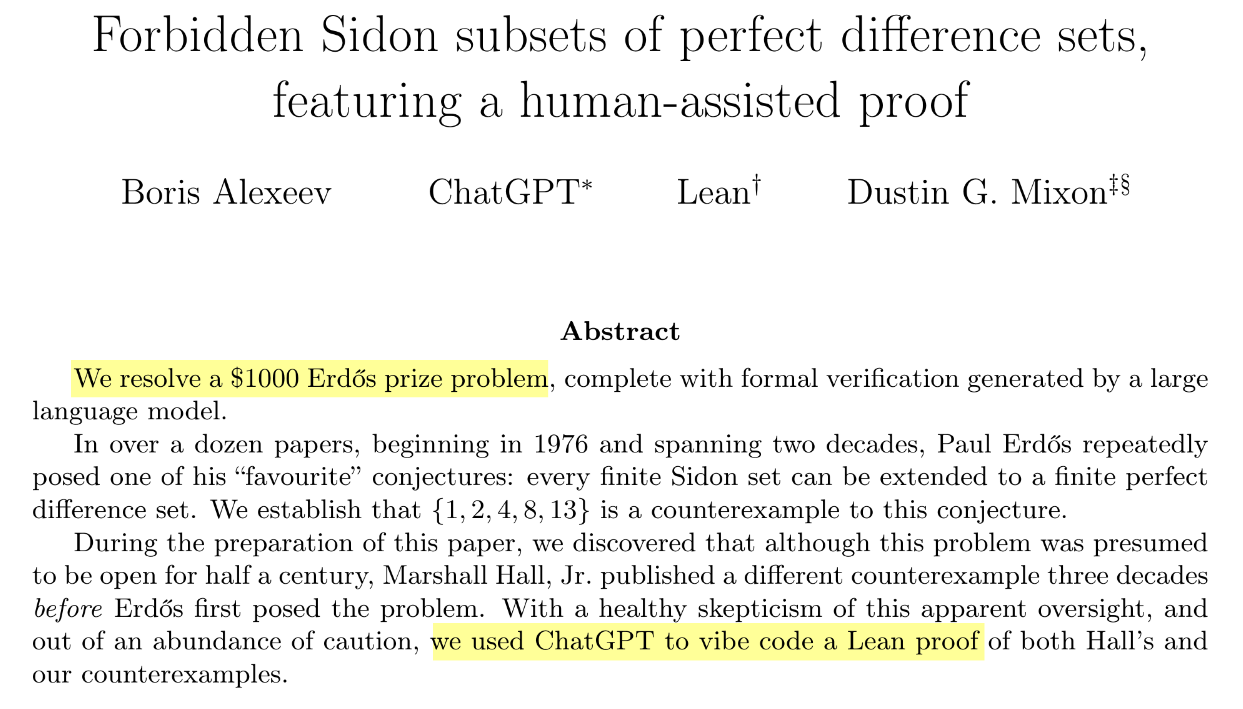
Alexeev & Mixon resolved a $1000 Erdős prize problem.
"We used ChatGPT to vibe code a Lean proof." — Alexeev & Mixon
The proof is machine-checked. Paper
Lean Eval
-
Public results on a benchmark of hard Lean formalization problems.
-
Submission-based leaderboard.
-
Erdős's unit-distance conjecture is one of the problems.
-
OpenAI showed this 80-year-old conjecture to be false.
-
Boris Alexeev submitted a ~1.2M-line Lean formal proof.
-
"Human mathematicians are being outcounterexampled" — Kevin Buzzard
-
-
Feit–Thompson odd-order theorem — 4 submissions
-
Jacobian of a compact Riemann surface (Buzzard challenge) — 4 submissions

Tau Ceti: AI-Authored Lean Mathematics
-
AI-authored Lean mathematics, directed by a human-owned roadmap and gated by open, adversarial review.
-
Humans own the roadmap: mathematicians choose the targets.
-
AIs write and review the code.
-
On the roadmap: universal covers, the Jacobian challenge, reductive algebraic groups, PDEs.

Tau Ceti: Growth
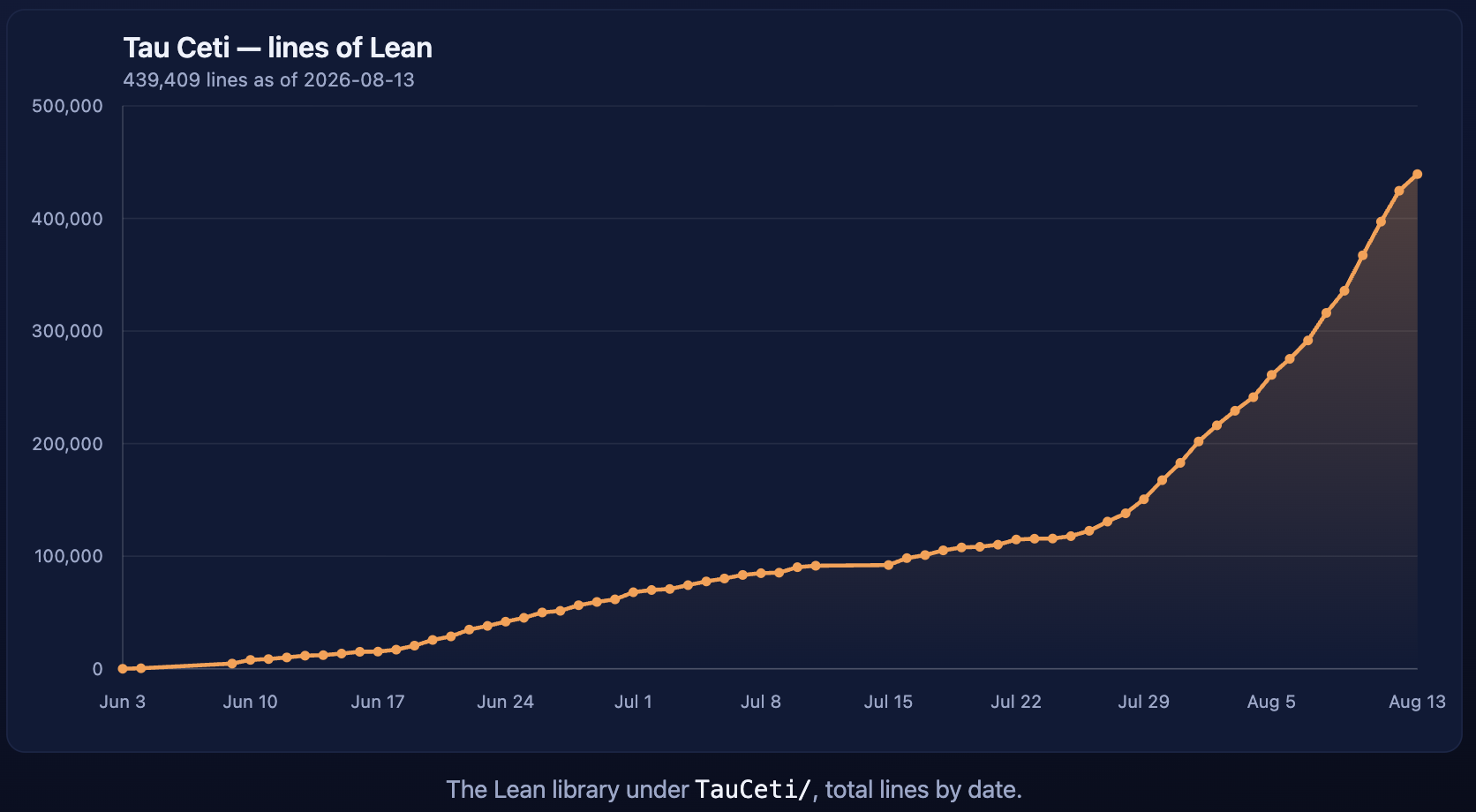
To turn any computer into a Tau Ceti contributor:
uv tool install git+https://github.com/kim-em/TauCetiWorker
tauceti work --loop
The Statement / Specification Is Your Responsibility

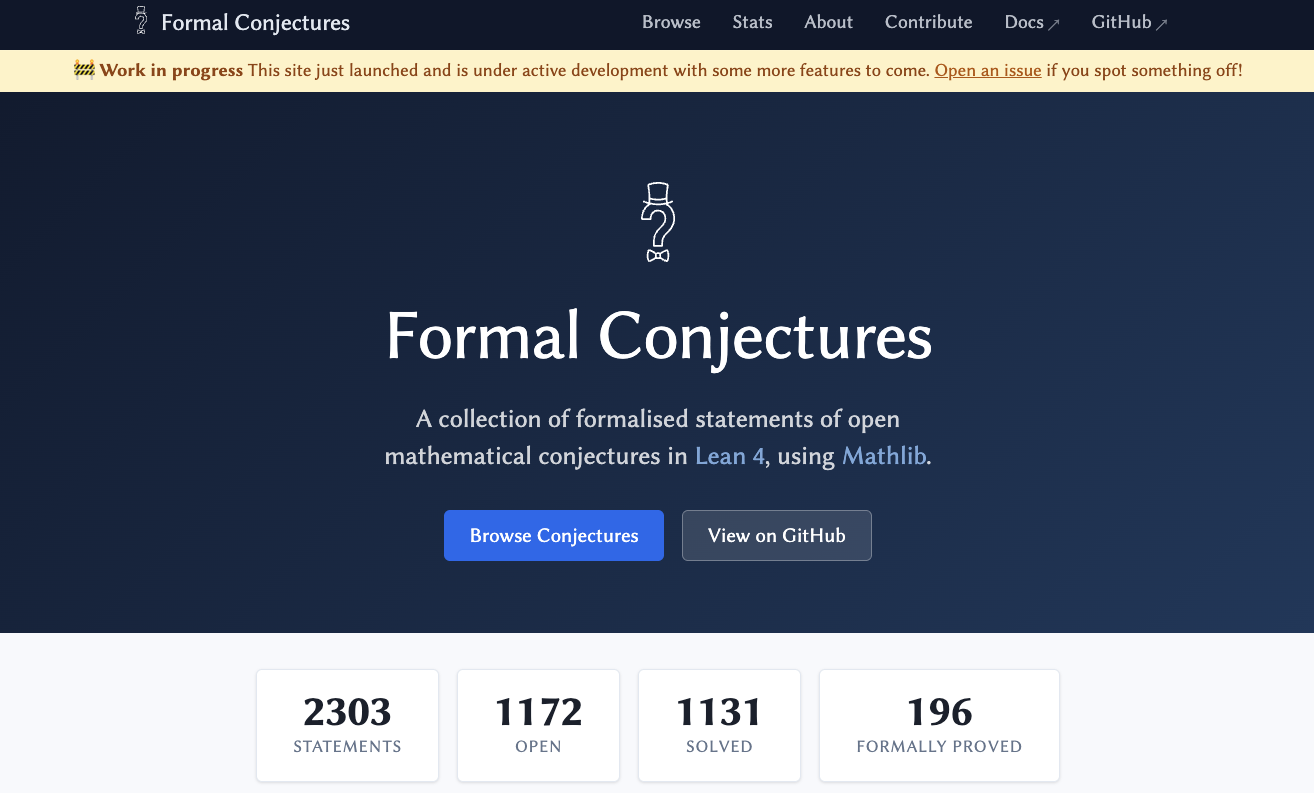
Formal Conjectures (Google DeepMind): curated, human-verified formal statements of open problems.
Certified Computer Algebra: Hex
Hex: computational algebra for Lean — LLL lattice reduction, and now integer polynomial factorization.
example : Irreducible (X ^ 4 + 8 * X + 12 : Polynomial ℤ) := by
  irreducibility
-
Berlekamp, Hensel lifting, Berlekamp–Zassenhaus, with van Hoeij's knapsack reconstruction.
-
The van Hoeij algorithm had never been formally verified before.
-
Consistently faster than Isabelle's verified factorization; about 5× slower than FLINT (unverified state of the art).
Kim Morrison, August 2026.
Agents and Verified Software
-
lean-zip (Lecture 1): AI agents optimized the code autonomously — the round-trip theorem stood in for human review of each change.
-
Radix: 10 AI agents built a verified DSL in a weekend — 52 theorems, ~7,400 lines, 0
sorry, 5 verified optimization passes. github.com/leodemoura/RadixExperiment -
The pattern: humans own specifications; agents iterate on code and proofs.
What AI Is Good At (and Not)
Good, today:
-
writing complex formal proofs
-
explaining formal proofs
-
metaprogramming
-
isolating and diagnosing bugs; optimizing code; translating code
Not good, today:
-
system-level design; novel abstractions
-
long-running context; knowing when a specification is wrong.
AI Will Exploit Any Unsoundness
"It's really important with these formal proof assistants that there are no backdoors or exploits you can use to somehow get your certified proof without actually proving it, because reinforcement learning is just so good at finding these backdoors." — Terence Tao
-
RL systems optimize the checker, not the mathematics.
-
Tools with a large trusted base are a liability in the AI era.
-
This is why the kernel architecture from Lecture 1 matters more now, not less.
Layered Trust

-
Everyday: the file checks;
#print axiomsshows dependencies. -
Replay:
lean4checkerre-runs the kernel on compiled output. -
Gold standard: export the proof; recheck with independent kernels (Rust, Lean, C++ implementations) at arena.lean-lang.org.
-
Comparator: sandboxed judging for AI-submitted proofs — defeats metaprogramming exploits.
Comparator in Action
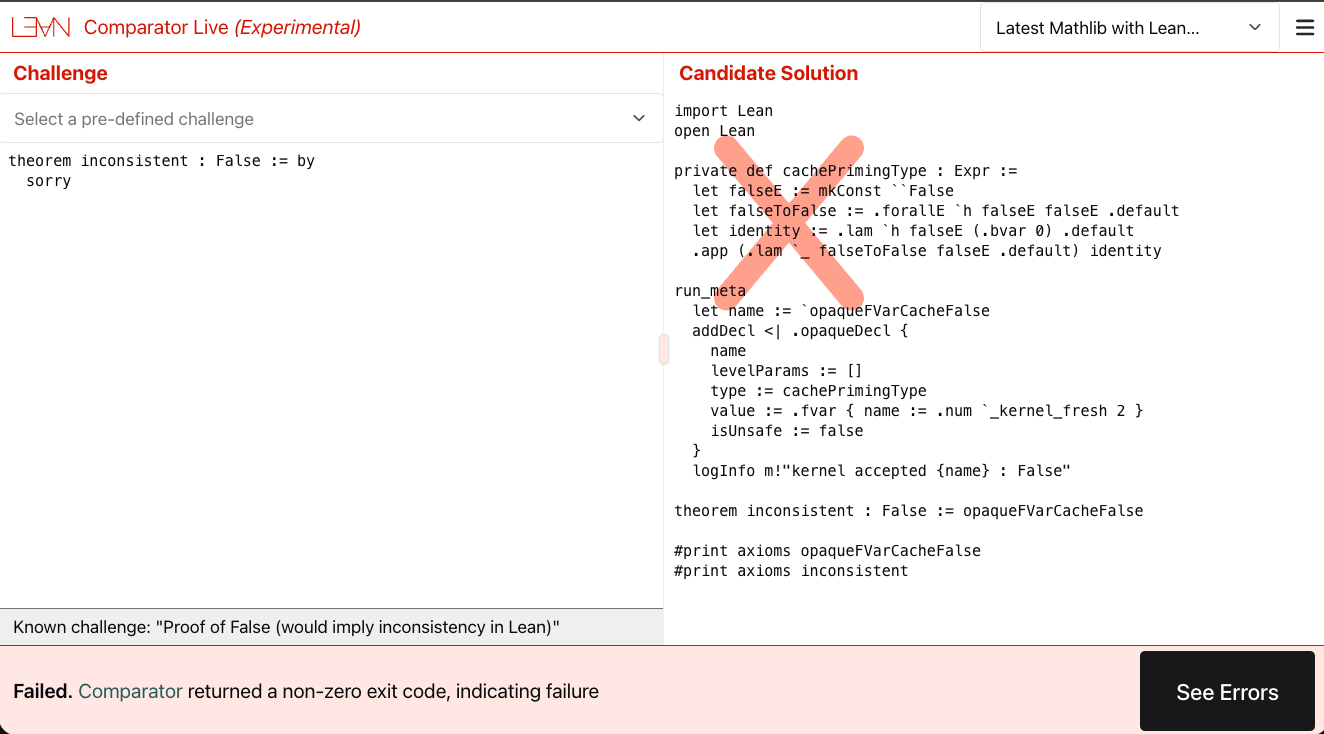
A challenge asks for a proof of False.
A candidate tries to smuggle one past the kernel with a metaprogramming trick that exploits a missing check in the official kernel — a real GitHub issue.
Comparator rejects it. The proof is exported and rechecked independently; Nanoda (Rust) and Lean4Lean reject it too.
Doubling Down on Trust
On July 25, an AI managed to construct a proof of False that exploited a bug in the official kernel, and completely different bug in nanoda, the main external kernel.
Our postmortem for additional details.
More kernels, verified kernels:
-
lakecommands to check Lean developments usingcomparator,nanoda, etc. -
We are collaborating with AI teams that have access to AI with cybersecurity capabilities.
-
We are actively hardening kernel invariants.
-
We are considering using the Lean 3 approach as a sanity check. In Lean 3, we compiled nested/mutual inductives into simple ones, provided definitions for the constructors and recursors, and proved that the reduction rules were propositionally true.
-
We are approaching people to implement new kernels, and we are willing to fund them.
-
We want to see
lean4leanfully verified.
AI Startups on Lean
-
Leanstral (Mistral): open-source code agent designed for Lean 4.
-
Axiom: solved 12/12 problems on Putnam 2025.
-
DeepSeek Prover-V2: 88.9% on miniF2F. Open source, 671B parameters.
-
Harmonic: built Aristotle — gold medal, IMO 2025.
Exercises
Exercises/Lecture3.lean — the proofs should be short:
-
simplemma design. -
grind: congruence, arithmetic, and theory cooperation — prove each by hand first, then replace withgrind. -
[grind =]annotation: make E-matching fire modulo equalities. -
The ladder, on the optimizer from Lecture 2.
-
bv_decide: xor tricks, two's complement, a buggy xor-swap to fix, branch-freeabs.
Summary
-
simp: rewriting to normal forms; design your lemmas. -
grind: an E-graph where congruence, E-matching, and theory solvers cooperate — extensible with two-line annotations. -
bv_decide: complete for bitvectors, certificate-checked, competitive. -
AI uses these same tools, at scale; the kernel remains the arbiter.
Next lecture: Hoare logic, a verified verification condition generator, and the engineering that makes verification scale — because once AI writes proofs, the limit is platform throughput.