
Scalable Software Verification in Lean 4
Signal Shot
The Liquid Tensor Experiment was Lean's moment with mathematics.
Signal Shot is our moment with software.

Lean
-
A programming language and a proof assistant
-
Lean is implemented in Lean. Very extensible.
-
Small trusted kernel. Proofs can be exported and checked independently. Multiple independent kernels.
-
Lean FRO: 20 engineers building Lean full-time.
-
Mathlib: 200,000+ theorems, 750+ contributors, 2.2M+ LoC
-
CSLib: a Mathlib for computer science
-
242,000+ unique installations: VS Code (140K) + Open VSX (102K). 8,000+ GitHub repositories.
-
These slides were written in Lean using Verso, so every code example in the talk is type-checked.
"Lean has become the de facto choice for AI-based systems of mathematical reasoning." — ACM SIGPLAN Award
Mathematics Runs on Lean
Six Fields Medalists engaged: Tao, Scholze, Viazovska, Gowers, Hairer, Freedman.
-
Liquid Tensor Experiment: verified a proof Scholze himself had "lingering doubts" about.
-
Equational Theories Project — Terence Tao
-
Fields Medal sphere packing — AI assisted
-
Fermat's Last Theorem — Kevin Buzzard
-
Mochizuki: formalization of IUT. Lean as a tool for communication.
Signal Shot needs non-trivial mathematics.
The Scaling Problem
Verification with proof assistants has not scaled so far.
Chlipala's group documented this for Rocq. The same story holds in Lean.
The bottleneck is the platform. Not AI capability. Not human time.
Lean@Google Hackathon
Andres Erbsen — Google ISE Formal. Bedrock2. Fiat Cryptography.
A Rocq veteran distilled the scaling problem into a minimal Lean challenge.
A small deeply embedded imperative language.
inductive Binop where
  | add | sub
  deriving Repr

inductive Expr where
  | literal (v: Int)
  | var (x: String)
  | op (bop : Binop) (e1 e2 : Expr)
  deriving Repr

inductive Cmd where
  | skip : Cmd
  | set : String → Expr → Cmd
  | seq : Cmd → Cmd → Cmd
  | input : String → Cmd
  -- ..
  deriving Repr

abbrev Memory       := PartialMap Word Byte
abbrev LocalContext := PartialMap String Word
Andres' Challenge — Operational Semantics
inductive IOEvent
| IN : Word → IOEvent
| OUT : Word → IOEvent
abbrev Post := List IOEvent → Memory → LocalContext → Prop
inductive Exec : Cmd → List IOEvent → Memory → LocalContext → Post → Prop
| skip : post es m l → Exec .skip es m l post
| seq : Exec c1 es m l mid →
(∀ es' m' l', mid es' m' l' → Exec c2 es' m' l' post) →
Exec (.seq c1 c2) es m l post
| set : (h_eval : Expr.eval m l e = some v) →
(h_post : post es m (PartialMap.put l x v)) →
Exec (.set x e) es m l post
| input : (∀ v, post (IOEvent.IN v :: es) m (PartialMap.put l x v)) →
Exec (.input x) es m l post
-- ..
theorem Exec.seq_cps (c1 c2 : Cmd) (es : List IOEvent)
(m : Memory) (l : LocalContext) (post : Post)
: Exec c1 es m l (fun es' m' l' => Exec c2 es' m' l' post) →
Exec (.seq c1 c2) es m l post := by
intro h; apply Exec.seq; apply h; intros; assumption
Andres' Challenge — A Parametric Program
notation:130 a " ;;\n" b => Cmd.seq a b
notation:150 x " ::= " e:150 => Cmd.set x e
notation:160 a " +' " b:160 => Expr.op Binop.add (Expr.var a) (Expr.var b)
notation:160 a " -' " b:160 => Expr.op Binop.sub (Expr.var a) (Expr.var b)

/-
Generates a command sequence of the form
input b
a := b
a := a + a; a := a - b
...
a := a + a; a := a - b
-/
def generated_cmd (n : Nat) (a b : String) : Cmd :=
  .input b ;;
  a ::= .var b ;;
  repeated_cmds n a b

abbrev spec (m : Memory) : Post :=
  fun es m' l =>
    m' = m ∧
    ∃ v : Word, es = [IOEvent.IN v] ∧ l.get "a" = some v

def Goal (n : Nat) : Prop :=
  ∀ m l, Exec (generated_cmd n "a" "b") [] m l (spec m)
Andres' Challenge — An Example
Each goal is a metavariable: a typed hole in a local context. apply thm unifies the goal with thm's conclusion and emits one new metavariable per remaining premise.
macro "step" : tactic =>
`(tactic| (apply Exec.seq_cps; apply Exec.set; simp_vc; rfl))
example : Goal 1 := by
intro m l; simp only [generated_cmd, repeated_cmds]; unfold spec
-- input b
apply Exec.seq_cps
apply Exec.input
intro v
-- a := b
apply Exec.seq_cps
apply Exec.set
simp_vc
rfl
-- a := a + a
step
-- a := a - b
step
-- skip
apply Exec.skip
simp only [List.cons.injEq, IOEvent.IN.injEq, and_true, PartialMap.put_put,
PartialMap.get_put, Option.some.injEq, and_self, exists_eq']
Andres' Challenge — Baseline
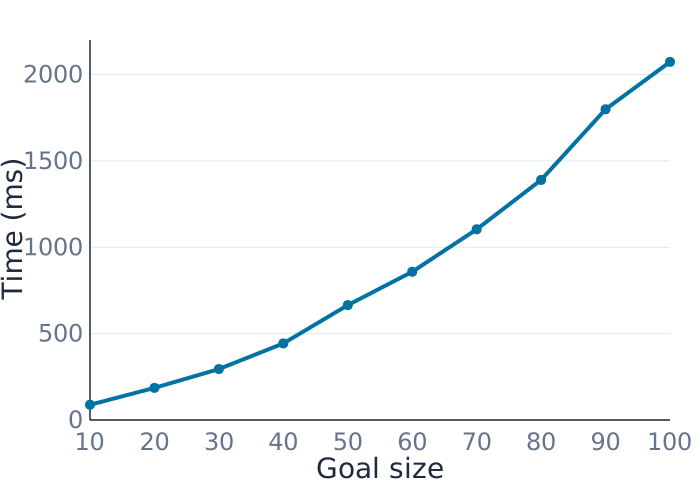
With Lean's default tactic framework, MetaM. Superlinear behavior.
| Goal | Tactics | Kernel |
|---|---|---|
goal_10 | 88 ms | 5 ms |
goal_50 | 665 ms | 42 ms |
goal_100 | 2073 ms | 161 ms |
VC Generation
A VC generator turns code and specifications into proof obligations.
Lean-based VC generators:
-
Aeneas — Rust verification via translation to Lean.
-
Velvet — a Dafny-style verifier built in Lean.
-
mvcgen — Lean's VC generator for monadic programs.
All three share the idiom we just saw.
What Must Be Fast
-
Efficient
apply. -
Efficient metavariable management.
-
Preserve term sharing.
-
Reuse
simpresults across VCs and across simulation steps. -
Do not traverse the same subterms over and over.
Son Ho's Observation
Aeneas emits many verification conditions.
Each corresponds roughly to an execution path. They share many hypotheses — and automation redoes the same work on each.
We must carry the state of the proof automation that discharges the easy cases.
SymM
A monad for symbolic simulation and VC generation.
-
Proof state lives in a restricted world.
-
Terms are kept maximally shared.
-
Specialized metadata and user extensions live in the state.
-
Operations are engineered for the VC loop, not for general interactive proving.
The Key Invariant
The local context monotonically grows during symbolic simulation.
-
We introduce local declarations and hypotheses.
-
We do not revert them.
-
We do not delete hypotheses.
-
Shared terms stay shared.
MetaM must support arbitrary proof-state surgery. VC generation does not need that power.
Once contexts only grow and terms stay shared:
-
scope checks around
?m := ebecome cheap, -
pointer equality becomes a valid cache key,
-
automation state survives from one VC to the next.
Shared Terms, Shared Work
SymM caches metadata on shared subterms:
-
maximal free variable, inferred type, level,
-
congruence information,
-
cheap definitional-equality queries.
Every operation preserves the sharing:
-
rewrite, abstract under binders, instantiate, beta-reduce.
The VC loop stops turning one shared DAG into copied trees.
Cheap Matching
Kernel convertibility is powerful: β / δ / ι / ζ / η plus proof irrelevance.
VC generation pays for that power over and over.
SymM preprocesses patterns once, then matches mostly syntactically.
-
No unfolding in the hot path.
-
Avoid fresh metavariables whenever arguments can be assigned immediately.
apply uses a precompiled backward rule. Only genuinely-unknown premises become subgoals.
A Verifier in SymM
partial def solve (mvarId : MVarId) : SymM Unit := do
let exec_cpsRule ← mkBackwardRuleFromDecl ``Exec.seq_cps
let inputRule ← mkBackwardRuleFromDecl ``Exec.input
let skipRule ← mkBackwardRuleFromDecl ``Exec.skip
let setRule ← mkBackwardRuleFromDecl ``Exec.set
let rflRule ← mkBackwardRuleFromDecl ``Eq.refl
let mvarId ← preprocessMVar mvarId
-- `intro m l`
let .goal _ mvarId ← Sym.introN mvarId 2 | failure
let mvarId ← simpUnfold mvarId
-- `apply Exec.seq_cps`
let .goals [mvarId] ← exec_cpsRule.apply mvarId | failure
-- `apply Exec.input`
let .goals [mvarId] ← inputRule.apply mvarId | failure
-- `intro v`
let .goal _ mvarId ← Sym.introN mvarId 1 | failure
let rec loop (mvarId : MVarId) : SymM MVarId := do
let .goals [mvarId] ← exec_cpsRule.apply mvarId | return mvarId
let .goals [mvarId', mvarId, _] ← setRule.apply mvarId | failure
let mvarId' ← simpVC mvarId'
let .goals [] ← rflRule.apply mvarId' | failure
loop mvarId
let mvarId ← loop mvarId
let .goals [mvarId] ← skipRule.apply mvarId | failure
simpFinal mvarId
example : Goal 10 := by
unfold Goal; run_tac liftSym solve
Andres' Challenge — SymM
-
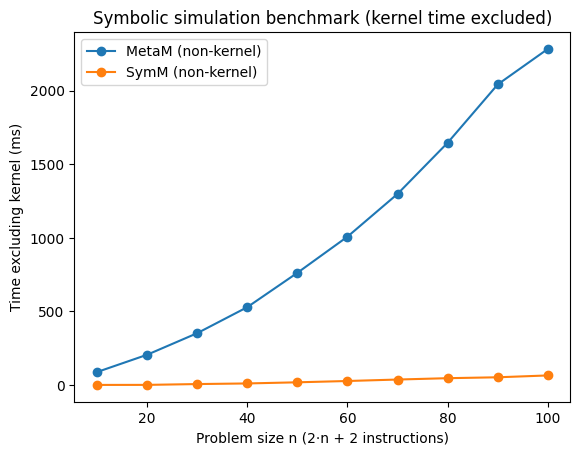
MetaM: 2073 ms at n=100. Superlinear. Fails before n=700.
-
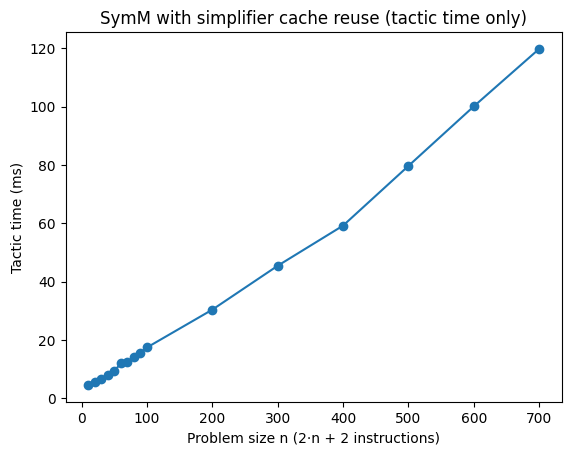
SymM + simp-in-loop: 16 ms at n=100. ~100× faster.
-
Linear out to n=700. 120 ms.
Why Meta.simp Does Not Scale Here
Meta.simp is general-purpose.
VC generation pays for features it does not need:
-
expensive
isDefEqin rewrite matching, -
inefficient binder traversal,
-
contextual control-flow simplification that explodes.
So we built a new simplifier for the actual workload.
A New Simplifier (1/4) — Shared Terms, Shared Results
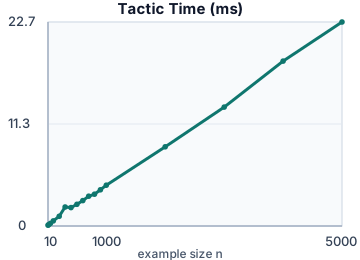
-
Pointer-keyed caches on maximally shared terms.
-
Pattern-based rewriting instead of general
isDefEqin the hot path. -
Proof construction engineered not to reconstruct giant terms.
-
Cached results persist across repeated
simpcalls inside the VC loop.
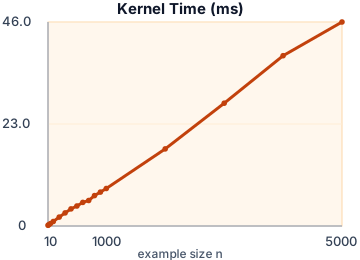
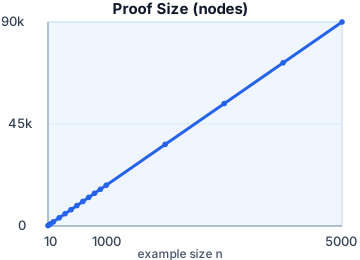
def n_5 := f (0 + f (0 + f (0 + f (0 + f (0 + x)))))
A New Simplifier (2/4) — Binders Without Quadratic Pain
-
Descends under
let/have,λ, and∀. -
Custom congruence machinery for binders.
-
Preserve
let/havebinders by default. -
Tracks the changed subterms, not repeated reconstruction of the whole telescope.
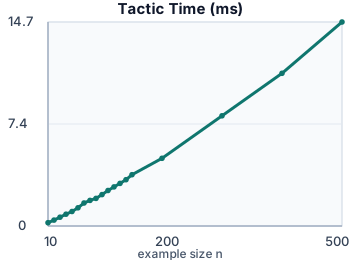
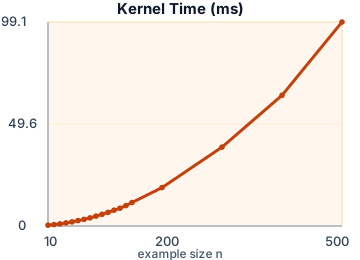
def ex_4 :=
  have y := 0 + (x + 4);   have y_1 := 0 + (x + 3);
  have y_2 := 0 + (x + 2); have y_3 := 0 + (x + 1);
  y_3 + (y_2 + (y_1 + (y + 0)))
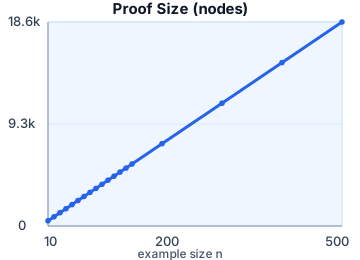
A New Simplifier (3/4) — Control Flow and Simproc
-
Simplify the condition or discriminant.
-
Do not eagerly simplify both branches.
-
Leave symbolic case-splitting to the simulator.
Simproc is the programmable layer VC generators use:
-
prehooks before descent,posthooks after descent, -
compose rewriting, ground evaluation, control-flow, and domain-specific passes.
elab "sym_simp" "[" declNames:ident,* "]" : tactic => do
let declNames ← declNames.getElems.mapM fun s => realizeGlobalConstNoOverload s.raw
let rewrite ← Sym.mkSimprocFor declNames Sym.Simp.dischargeSimpSelf
let methods : Sym.Simp.Methods := {
pre := Sym.Simp.simpControl
post := Sym.Simp.evalGround >> rewrite
}
liftMetaTactic1 fun mvarId => Sym.SymM.run do
let mvarId ← Sym.preprocessMVar mvarId
(← Sym.simpGoal mvarId methods).toOption
example (f g : Nat → Nat) : (if a + 0 = a then f else g) a = f a := by
sym_simp [Nat.add_zero]
A New Simplifier (4/4) — Context-Dependent Caching
Some simplifications depend only on the term.
Others depend on the local context: hypotheses, discharge success, binder-local assumptions.
Every result carries a contextDependent bit.
-
Context-free results go in a persistent cache.
-
Context-dependent results go in a transient cache.
-
Reset the transient cache when entering binders and at each top-level
simprun.
We do not give up caching because some rewrites are contextual.
We separate contextual results from non-contextual ones.
cbv
cbv performs simplification that closely mimics call-by-value evaluation and is proof producing.
It is implemented on top of the new simplifier. Wojciech Różowski (Lean FRO).
It works with functions defined via well-founded recursion or partial fixpoints.
def numbers : List String :=
["zero", "one", "two", "three", "four", "five", "six", "seven", "eight", "nine"]
def numberToNumber : Std.HashMap String Nat :=
(0...=9).iter.fold (init := ∅) (fun sofar num => sofar.insert numbers[num]! num)
def sortNumbers (str : String) : String :=
str.split ' '
|>.filter (!·.isEmpty)
|>.map (numberToNumber[·.copy]!)
|>.toList
|>.mergeSort
|>.map (numbers[·]!)
|> String.intercalate " "
example : sortNumbers "five three" = "three five" := by cbv
example : sortNumbers "six one two" = "one two six" := by cbv
grind
New proof automation, shipped in Lean v4.22. Kim Morrison and me.
A virtual whiteboard, inspired by modern SMT solvers.
-
Writes facts on the board. Merges equivalent terms.
-
Cooperating engines: congruence closure, E-matching, constraint propagation, guided case analysis.
-
Satellite theory solvers: cutsat (linear integer arithmetic), commutative rings (Gröbner), linarith, AC.
-
Native to dependent type theory. No translation to FOL.
-
Produces ordinary Lean proof terms. Kernel-checkable.
The E-graph is the central data structure. Satellite solvers read from it and propagate back.
grind — Theory Combination
example [CommRing α] [NoNatZeroDivisors α]
(a b c : α) (f : α → Nat)
: a + b + c = 3 →
a^2 + b^2 + c^2 = 5 →
a^3 + b^3 + c^3 = 7 →
f (a^4 + b^4) + f (9 - c^4) ≠ 1 := by
grind
Three solvers meet at the E-graph:
-
Ring solver derives
a^4 + b^4 = 9 - c^4. -
Congruence closure lifts it to
f (a^4 + b^4) = f (9 - c^4). -
Linear integer arithmetic closes
2 * f (9 - c^4) ≠ 1.
The Nelson-Oppen playbook. Inside dependent type theory. No SMT translation layer.
grind — Typeclass-Parameterized Theory Solvers
Satellite solvers activate automatically when the type classes are present.
-
cutsat—ToIntclass.Int,Int32,BitVec 64,Fin n. -
Ring —
CommRing,CommSemiring,Field,IsCharP,NoNatZeroDivisors. -
linarith— module over the integers. Preorders, partial, linear orders. -
AC — any associative-commutative operator.
example (x y : Int)
: 27 ≤ 11*x + 13*y → 11*x + 13*y ≤ 45 →
-10 ≤ 7*x - 9*y → 7*x - 9*y ≤ 4 → False := by
grind
-- BitVec 8 is a CommRing of characteristic 256.
-- No bitvector-specific theory needed.
example (x : BitVec 8) : (x - 16) * (x + 16) = x^2 := by
grind
grind — Annotations and E-Matching
Library authors annotate theorems; grind instantiates them by E-matching — pattern matching modulo the E-graph.
-
[grind =]— use the LHS as the E-matching pattern. -
[grind →]— forward reasoning: patterns from hypotheses. -
[grind ←]— backward reasoning: patterns from the conclusion. -
grind_pattern— custom multi-patterns. -
Constraint system on patterns:
guard,check,is_value,is_strict_value.
@[grind =] theorem fg {x} : f (g x) = x := by
unfold f g; omega
example {a b c} : f a = b → a = g c → b = c := by
grind
4,000+ grind uses in Mathlib.
Threading grind State — Grind.Goal
In SymM-based VC generators, tactics thread Grind.Goal instead of MVarId.
A Grind.Goal pairs the MVarId with the grind state. Shared across every VC that inherits it.
The state carries:
-
E-graph — every discovered equality and propagated fact.
-
Instantiated theorems — what E-matching has already fired.
-
Satellite solver states.
SymM Interactive Mode
Humans and AI both need to inspect and steer VC generation.
example (p q : Prop) : p → q → p ∧ q := by
sym =>
intro hp hq
apply And.intro
apply hp
apply hq
register_sym_simp chainSimp where
post := ground >> rewrite [Nat.add_zero, Nat.zero_add]
example (x y : Nat) (h : x ≤ y) : (1 - 1) + x ≤ 2*y + (1 + 0) := by
sym =>
simp chainSimp
lia
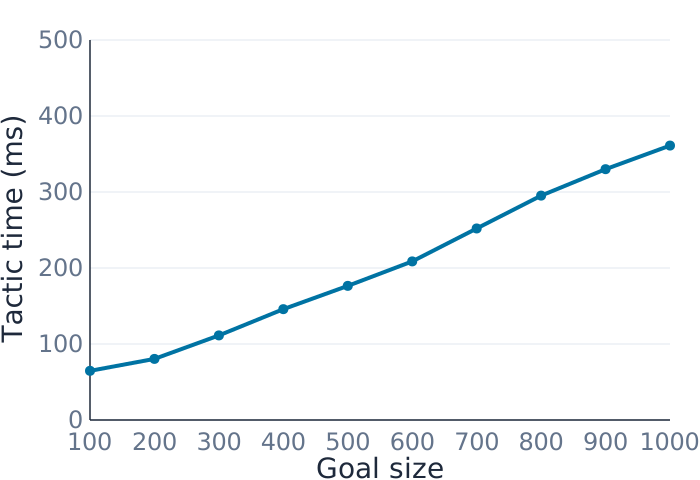
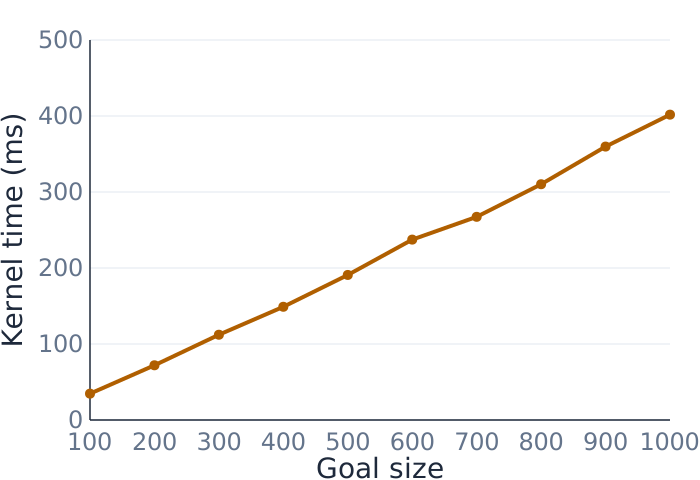
mvcgen — Ported to SymM
Lean's VC generator for monadic programs. Ported to SymM by Sebastian Graf (Lean FRO).
Andres' challenge using Lean monadic code. Linear out to n=1000.
Velvet — Ported to SymM
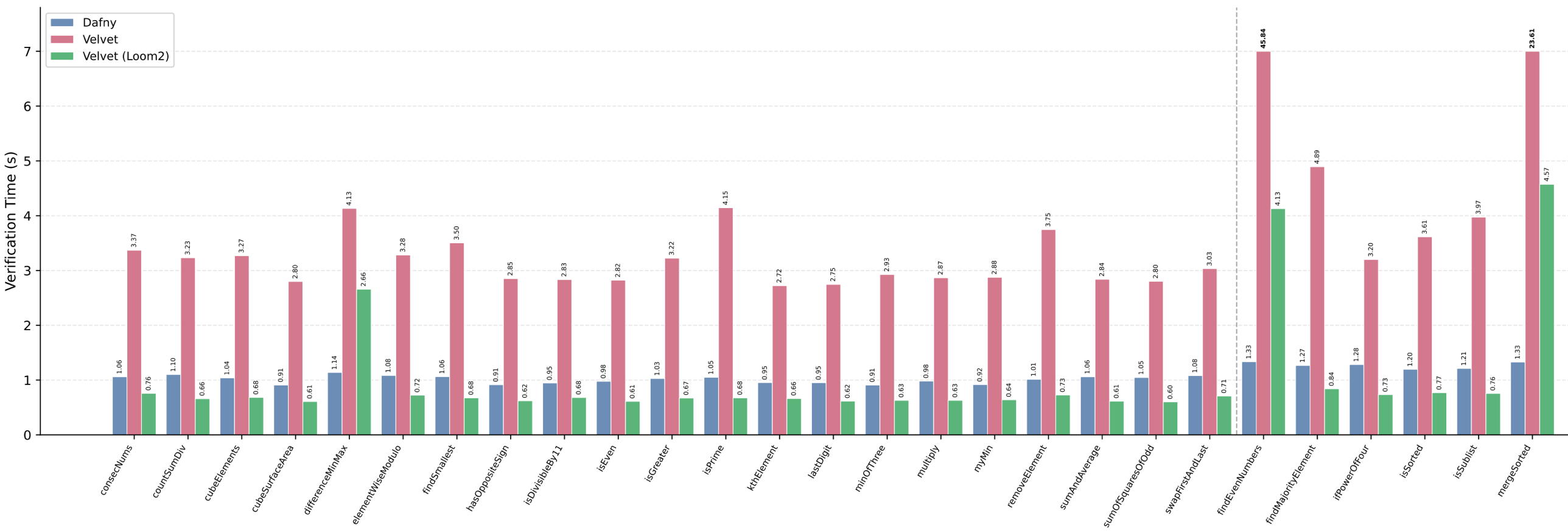
A Dafny-style verifier in Lean. Ported to SymM by Vova (Lean FRO intern). Preliminary results.
-
Before: Velvet ran ~3× slower than Dafny.
-
After: Faster than Dafny on 24 of 27 benchmarks; competitive on the other 3 (
differenceMinMax,findEvenNumbers,mergeSorted).
One port beat Dafny on 24 of 27. Dafny has a vast TCB.
AI
The platform is ready.
AI is already using it.
zlib
A general-purpose AI converted zlib (a C compression library) to Lean, passed the test suite, and then proved the code correct. No custom prover. No special training.
theorem zlib_decompressSingle_compress (data : ByteArray) (level : UInt8)
    (hsize : data.size < 1024 * 1024 * 1024) :
    ZlibDecode.decompressSingle (ZlibEncode.compress data level) = .ok data
Round-trip correctness for compress / decompressSingle, machine-checked.
Radix Experiment
10 AI agents built a verified embedded DSL with proved optimizations over one weekend.
-
Zero
sorry— 52 theorems, all complete -
5 verified compiler optimizations
-
Determinism, type safety, memory safety — all proved
-
Interpreter correctness — sound and complete
-
27 modules, ~7,400 lines of Lean
-
I wrote zero lines. Full agent autonomy.
AI on Lean
To date, every AI achieving medal-level IMO performance with formal proofs used Lean.
-
AlphaProof (Google DeepMind) — silver medal, IMO 2024
-
Aristotle (Harmonic) — gold medal, IMO 2025
-
SEED Prover (ByteDance) — silver medal, IMO 2025
Three independent teams. Every one used Lean.
Recent AI Results
-
Axiom: 12/12 on Putnam 2025.
-
DeepSeek Prover-V2: 88.9% on MiniF2F-test. Open-source, 671B parameters.
-
Harmonic: Built the Aristotle AI — gold medal, IMO 2025
None of these systems existed in early 2024.
Automation in the AI Era
-
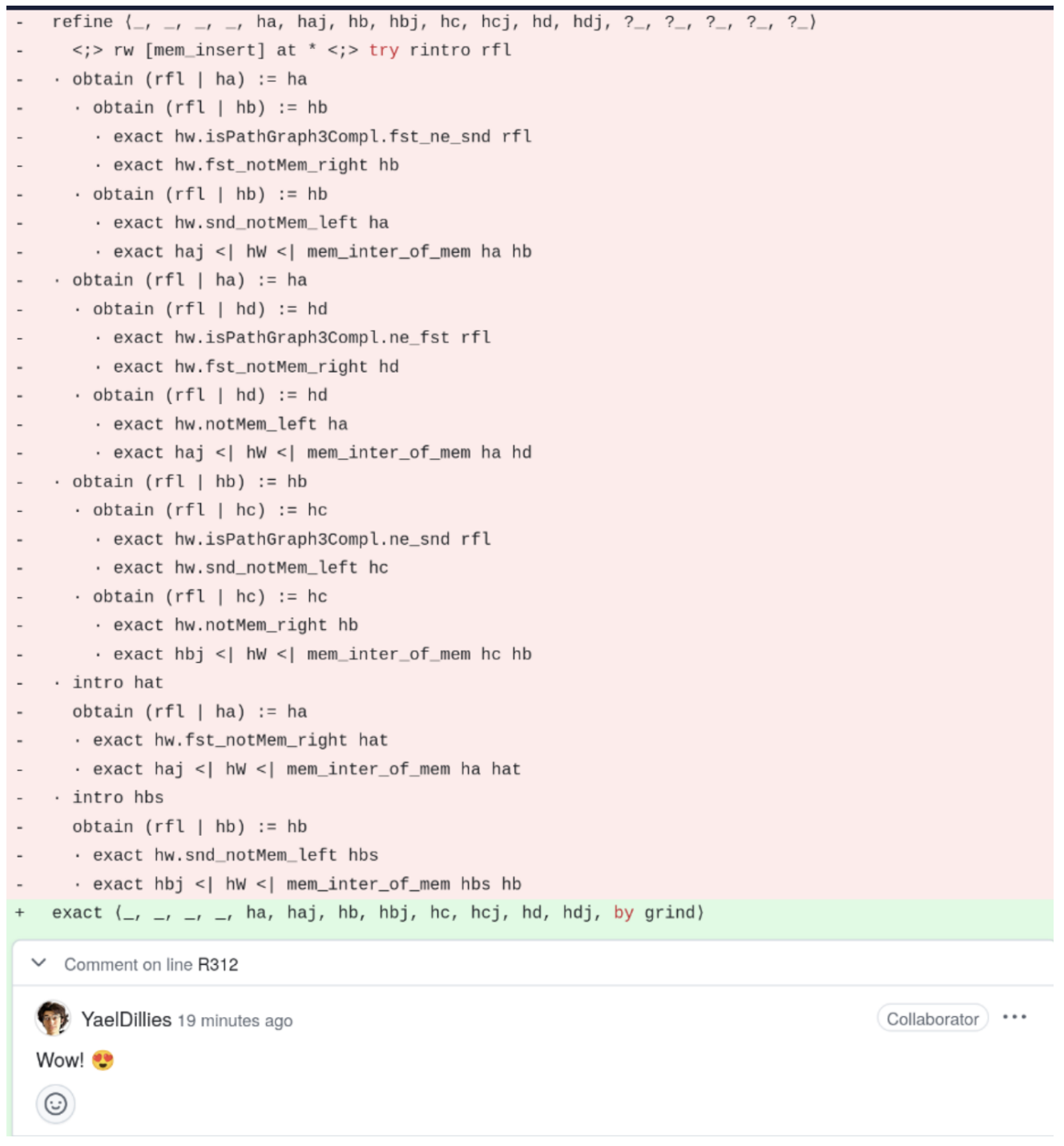
grindcloses in one step what takes fifty. The AI search tree shrinks. -
Compact proofs = better training data = better AI provers.
-
I built Z3's heuristics by hand. AI does that better now. The algorithmic core still matters more, not less: congruence closure, linear arithmetic, decision procedures.
-
By default: a dumb and fast
grind.
Trust
AI makes proofs cheap.
Trust remains expensive.
Trust — AI Will Exploit Any Unsoundness
"It's really important with these formal proof assistants that there are no backdoors or exploits you can use to somehow get your certified proof without actually proving it, because reinforcement learning is just so good at finding these backdoors." — Terence Tao
Tools with large TCBs are a liability.
Trust in Lean is layered. Each layer shrinks what you have to trust.
-
Everyday: blue check +
#print axioms. -
Replay:
lean4checkerre-runs the kernel on.oleanoutput. -
Gold standard:
comparatorin a sandbox with multiple independent kernels.
TCB = Liability
Other verification tools trust the SMT solver and the VC generator. Large surface.
Lean: trust the kernel. And we have more than one.
-
Standard axioms:
propext,Classical.choice,Quot.sound. -
sorryAxsurfaces incomplete proofs. Custom axioms surface themselves via#print axioms. -
The Lean compiler is not in the TCB for proofs.
Multiple Independent Kernels
arena.lean-lang.org hosts independent kernel implementations.
-
The reference kernel — C++.
-
nanoda— Rust. -
lean4lean— Lean. -
More under way.
Anyone can build a kernel and submit it.
Disagreement between independent kernels exposes bugs that neither would catch alone.
Validate Proofs Independently
lean4checker replays .olean declarations through the kernel in a fresh context. Catches bugs in meta-programs that bypass the kernel or corrupt memory.
Comparator builds the proof in a sandbox, exports it, and replays through nanoda or the reference kernel.
Coming soon: Comparator at live.lean-lang.org.
Additional TCB for Signal Shot (beyond the Lean kernel and standard axioms)
-
Our specifications
-
Charon & Aeneas
-
Rust Compiler
Verification does not eliminate trust. It relocates it to a surface we can audit.
Commitment
Lean will scale. The missing proof automation and features will be built:
-
Custom proof automation: new
grind/symtactics. -
grindattribute sets optimized for VC generators. -
Infrastructure for matching on goals.
-
Scalability. We will keep optimizing Lean and its kernel.
Conclusion
The Lean platform scales and is ready.
SymM and the new simplifier turn a superlinear bottleneck into a linear one.
-
Mathematics on Lean: Six Fields Medalists. Liquid Tensor Experiment. Fermat's Last Theorem. Sphere packing. Equational Theories Project. Tao's Analysis I. Mathlib: 200,000+ theorems.
-
AI on Lean: Every AI achieving medal-level IMO performance with formal proofs used Lean (AlphaProof, Aristotle, SEED Prover). Axiom: 12/12 on Putnam 2025. DeepSeek Prover-V2: 88.9% on MiniF2F. zlib verified by a general AI.
-
Trust: Multiple independent kernels. Comparator. Small TCB.
-
Adoption: 242,000+ unique installs. 8,000+ GitHub repositories.
-
Lean FRO: 20 engineers building Lean full-time.